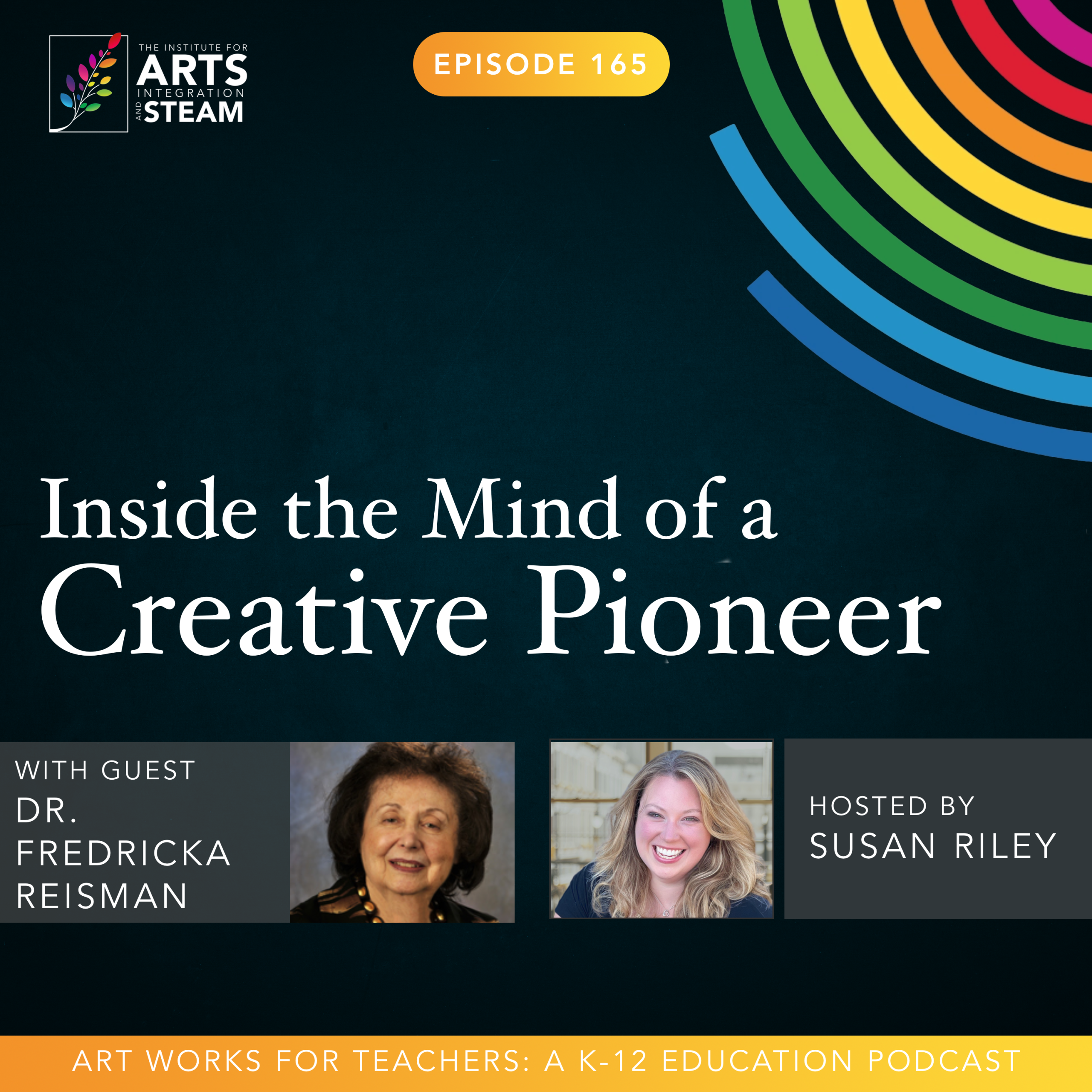
ART WORKS FOR TEACHERS PODCAST | EPISODE 165 | 22:48 MIN
Inside the Mind of a Creative Pioneer
 Resource Download
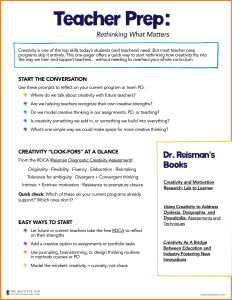
Enjoy this free download of the Teacher Prep Resource.
Susan
Welcome to the show, Fredricka. Thank you so much for joining me today.
Fredricka
It’s a pleasure to be here.
Susan
Of course. So I would, I would like to start with the stories of the people who are on board with me today. So I know that you’ve worn a lot of hats in education from being a teacher to a researcher and a founder. I would love to just hear your journey. What’s kept you passionate about creativity?
Fredricka
Well, it’s a pretty eclectic journey. I started out in pre-med and was accepted to Syracuse University’s new seven-year BS MD program. However, when it got to the anatomy class, I couldn’t dissect a cat. And I thought, if I can’t do this, what am I going to do with a cadaver? And my dad was an anesthesiologist and he was really happy that I was going into medicine. So, you know, he understood though. And so then I thought, okay, I’ll try law because one of my uncles was an assistant attorney general in New York state. And he was thrilled that I’d come into his law practice. So I took the LSAT and bombed it. Years later, my daughter entered kindergarten and came home and she could read and she was doing math and I thought, whoa, this is a real psychological study. And so Syracuse at that time started a program where you could go for the summer and get a job and then get your masters while you’re teaching and taking courses. And so I started out in third grade and then taught there for about three years and then was recruited by the school district where I lived and taught fifth grade and then entered a PhD program in math ed and they offered me an assistantship but I didn’t take it because I was about to get tenure in my school district. And so one day the superintendent showed up in my classroom and said, what’s this I hear about you have an assistantship at Syracuse? And I said, well, I told him what he said. You take it because you’ve got tenure right now. So then I did get my PhD. And they kept me on for a year. And Harold Rankin, who was that superintendent who gave me tenure, was in a PhD program. And I ended up on his committee. And he said to me, don’t you screw me, girl.
Susan
Return that favor, right? Return that favor.
Fredricka And so that’s how I ended up at Georgia. I just loved it. I took a course in how to give the bene and the whiskers from Alan Kaufman, who had just come to Georgia from Site Corp where he worked on the whiskers. by then was chair of the Division of Elementary Ed at Georgia. And I hired Alan’s wife, Nadine, to be involved with our failed experience. And James Kaufman, who’s a dear friend of mine today, was about eight, nine years old. And so that, that, Jaylee. It was a wonderful experience. I took, although I was a faculty member, I took every PhD course that Paul Torrance, with the help of his wife, Pansy.
Susan
Yes. So tell me a little bit about that because, you know, Torrance has really shaped the field of creativity research. And I’m fascinated by some of the things that he really investigated. What was that experience like for you to study with him? And what are some of the things you learned and took away?
Fredricka
I am so blessed that he became my mentor. He showed up at my office door one day when I was there probably about a year. And he asked if I would help him get the gifted program certified in Georgia. And I said, So we went to the state superintendent of education in Georgia. And we left his office with approval to have gifted certification. And from then on, Dr. Torrance and I did research together. We presented at conferences.
But a nice story, if I may. He and I gave the Torrance test of creativity to two first grade classes. And the kids also had to take the Metropolitan Readiness Test that was required. Well, there were two little boys. They were in different first grades classrooms. And their teachers said to Dr. Torrance and me, what these boys are such liars and they have such behavior problems. And so Dr. Torrance said, know, lying is very creative and now we have to show them how to do their lying in socially acceptable ways.
Susan
What a gem. That’s a gem.
Fredricka
And so Dr. Torrance and I suggested many activities for these kids. And the teachers agreed that they would implement what we suggested. But we went back in about, I don’t know, two or three weeks and the teachers said, these boys are brilliant. Now, just to backstab, when they did poorly on the Metropolitan, they were shoved into the special ed track. So these two boys, they ended up being tutors to their classmates in math and reading. The teachers were raving about them. Their attitude toward the kids, these two boys completely turned around and the two boys, of course, stopped the behavior problems and just were happy. And I mean, we changed the lives of two little boys.
Susan Riley
Yeah, you did. You did. What were some of the strategies that you had suggested that the teachers try that made such a difference?
Fredricka
Well, first Dr. Torrance suggested that the teachers take his TTCT so that they could become aware of their own creative strengths. So that was the first strategy that they needed to be aware of what creativity was all about. Then they would give their classes, not just these two boys, but they changed their whole method of teaching.
They had a safe environment so that the kids could make mistakes and say, that’s fine because we learn from our mistakes. They had different stations set up in their classrooms to grow plants or to just sit and think, a quiet section to write poetry. And they turn the whole classroom environment into an open, creative, caring environment.
Susan
I love that. I think that’s so powerful and it’s something means something we can use no matter what when it is right we can use it now it’ll be good 30 years from now you know it’s it’s part of what speaks to us as humans which I think is really important. One of your big contributions to creativity I know is your diagnostic creativity assessment. So for teachers who are listening, how can a tool like that help them notice or grow their own creative strengths or that of their students like the story that you just shared?
Fredricka
Well, the key is awareness, whether it be your awareness of your students’ creativity or awareness of your own creativity. And that’s the key. And I always use the Torrance test in my research. But then I was involved with an eighth, ninth, and tenth graders across the school district. And there were just too many teachers who would be taking the Torrance test for me or my team to score. Although I was trained to score by one of Dr. Torrance’s graduate students whose whole research was on scoring the TTCT.
That’s when I realized I’ve got to have a much shorter. and also when we would send it to the publisher, it was $25 for a kid or a teacher for a participant. And it would take them a month before they would send us back the results. That just wasn’t working.
So that’s how the RDCA was born. And it’s really built upon the Torrance test and Jay Paul Guilford’s work. And so I abstracted from their research 11 factors, originality, which is coming up with novel ideas, fluency, ability to generate many ideas, flexibility, generate many categories of ideas, tolerance of ambiguity, resistance to premature closure. Have you ever been in a conversation with someone and they finish your sentence and it’s not what you wanted to say? They’re not being creative. Divergent, convergent thinking. Divergent being generating a lot of ideas, convergent being, evaluating and coming to closure of one idea, an intrinsic extrinsic motivation, intrinsic being. You do something for the love of the task, extrinsic. You do something for some external reward, a smile from the teacher, a good grade. In the corporate world, it could be a promotion salary increase. Risk taking, but smart risk taking. And so I don’t know if I’ve hit all 11 of them. But the teachers, once they become aware of what to look for in the students in terms of these factors, then they’re able to hone in on the kids’ strengths and those factors that maybe, like maybe the kid has trouble, tolerating ambiguity. They have real problems socially and emotionally with it. If the teacher is aware of that, then they can work with them and say, you know, I have trouble with that too. You know, and work with them.
Susan
And I think what’s very exciting about this and what you said about the being aware is key that we’re so focused on standardized tests right now, right? We’re so that it almost knocks creativity to the sideline, like it’s a dessert instead of the main course. But with your test and with tests like that, we are then refocusing on these elements that really impact everything across the board. Everything, it impacts how we understand mathematics, how we engage with language, how we explore and get curious about science, right? And so I think what’s exciting about these tests is that it allows us to take our focus on standardized testing and place it in a place in a way that gives us openness and awareness to facilitate across all of the things that we’re trying to do.
Fredricka
And I’m in the process now of developing a book that provides activities to strengthen each of the 11 factors. Plus, there will be chapters that provide activities on classroom practices. fact, I’ve got about 43 activities in that chapter. There is a chapter for corporate activities, and military. And then there’s another chapter that deals with generic influences on learning. That’s another thing that teachers need to be aware of. The cognitive and creativity falls into the cognitive, the thinking. Psychomotor. One has visual or auditory perception problems, for example, social. How do they get along with their peers? Maybe they need some role play or help in that area, emotional. Do they get upset easily? And so the generic influences on learning affect learning. So it’s important to be aware of those also.
Susan
Absolutely, absolutely. So I’m curious, last fall I was able to speak with Dr. Jo Boaler about mathematics and creativity and as a former math educator or someone who loves math and science yourself and from your own work, how do you think that teachers can continue to shift how math is taught so that creativity becomes part of that experience?
Fredricka
Well, that’s a really important point, Susan, because one of the questions asks something about how does a teacher make space for creativity? You don’t make space. You live it. It becomes part of your everyday interaction with the world
I’m ashamed to say that at Drexel, the school of education which I started, the teacher prep program does not incorporate creativity. And I have offered to do workshops with the teachers because it’s key that the teacher, whether it be college professor or first grade teacher, you have to model creativity. Their excuse is, well, the state has so many requirements for certification, we just can’t add another course. And I keep telling them, no, you sprinkle it throughout. But there’s a real resistance worldwide to creativity. One of my former research assistants did a catalog survey of teacher preparation programs in the US. And out of almost 100, only eight incorporate studies in creativity. And I have a colleague in the UK who did a similar survey for me across Europe. And he found that it’s not as bad there. For example, in Switzerland, they really integrate creativity in their teaching. Finland also. I have a colleague in South Africa. Same thing. And I have another colleague in Australia. So the rest of the world is really far ahead of us in terms of integrating creativity. The corporate world in the States is ahead of education. They have, there’s even a position called talent manager where they hire someone who is able to facilitate their employees to develop their creativity.
Susan
Yeah. So my question is, we, and I totally agree, I have speaking with businesses and people from all around the world, we are behind in education in terms of integrating creativity. It’s one of our mission at the Institute. So my question to you is, why do you think that is? If we know that the corporate world values creativity, it’s on the top of their list. If we know that the rest of the world is moving in this direction, why do you think here in the US it’s been a challenge to embrace and to prioritize integrating creativity.
Fredricka
Because it’s incorporated in their teacher education program. Our students in the master’s program and the EDD program have expressed their anger to me that they never were exposed to creativity in their teacher education program. They’re really angry. So unless we start integrating it into teacher and programs, it’s going to remain a problem. In fact, at Drexel in our EDD program, the concentration and creativity has by far the largest number of students.
Susan
Yes. Well, I think that taps into who we are, right, just as human beings and how we operate within the world. We want to be able to express that in our profession, yes, and in the students that we’re working with, right?
Fredricka
Exactly, exactly. Even the undergraduates more and more are taking more of the creativity courses.
Susan
Yeah, why wouldn’t you, right? They’re fun and they’re engaging and they’re something that pulls on our brains in different ways, makes it something that feels really good to accomplish. There’s just so many benefits to it. Before I let you go though today, because we are running out of time, you talked about your new book. I would love to know, you know when that is coming out? Do you know what the title is so that we can kind of follow up with it?
Fredricka
Well, one that’s out, actually. The title is Connecting Creativity and Motivation Research with End-Users. The one that I’m working on now, which I hope will be able to access online. It’s Creativity Assessment and Enhancement, CAES, system, because it is a system. By the way, the RDCA is free. And this book now is supporting the RDCA with activities for each of the factors.
Susan
Excellent. Yes. And for clarity, folks, the RDCA is the assessment that we talked about earlier that Friedrich has created. And I think it’s something that if it’s free, we should all be leveraging it if we can.
Fredricka
And also, I was just amazed, but a colleague of mine, I’ve been friends with him for 35 years. He was the CEO of Vertex, which is the largest business software company in the world. His parents started it and then he took over. He donated a million and a half to Drexel to create the Freddie Reisman Center for translational research in creativity and motivation. And so they should look that up. If they just Google FRC, it’ll come up.
Susan
Yes, we will make sure that we put that in the show notes along with where they can get that assessment and your books so that we can make sure that we can continue to follow up on all of the incredible things and the legacy that you are leaving us. Thank you so much for your time today. I really appreciate it. Before we wrap up, I would love to know how can we stay in touch? How can we know more about you and stay up to date on what you’re working on?
Fredricka
Just email me at freddie at drexel.edu.
Susan
Excellent. Thank you so much for your time today and for allowing me to learn from you. It has been an honor.
Fredricka
Thank you for all that you do. This is wonderful what you do.
Susan
Thank you so much.