ART WORKS FOR TEACHERS PODCAST | EPISODE 163 | 32:19 MIN
Yes, Creativity Has an ROI (And Here’s How to Show It)
Everyone says creativity matters… but can you actually prove it moves the needle? In this episode, creative leadership expert Michael Ackerbauer is with us to unpack the measurable impact of creativity in schools, teams, and classrooms. If you’ve ever struggled to justify creative work to data-driven stakeholders, this conversation will give you the language (and the confidence) to finally make your case.
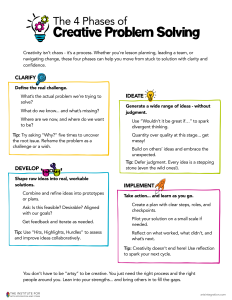 Resource Download
Enjoy this free download of the Creative Problem Solving Phases resource.
Hello, Michael, I’m so glad that you can join us today.
Michael
Hi, Susan. Glad to be here. Thank you.
Susan
Absolutely, absolutely. So I always ask our guests to just kind of share their story with us. Share how you got to where you are now and just kind of give us the big overview.
Michael
Sure. I’m a long time technology guy. Started out in my undergrad with management information systems. I started to learn Unix operating systems when it was a big deal that you had an alternative mainframes and things were becoming a little more decentralized. So I was in system administration and I learned a lot about helping teams and organizations build better systems over time.
I really like doing automated work, automation type work, and I just got very excited about what the technology could do for me. And I got very passionate about showing people what it could do and helping the businesses I work for improve their businesses because of it. Over time, I discovered that I was more passionate about developing the people who develop technology than developing the technology myself. So I went into management for a time where I learned how to not be a leader. You go into management to learn what leadership is and is not. And that was a really good schooling for me. And I did it a couple times and it was valuable. But along the way, I found this program in Buffalo called, at the time it was called the International Center for Studies and Creativity. And now it’s called the Center for Applied Imagination at Buffalo State University.
And in that journey, I was in four very small to medium-sized businesses, startups, and then for IBM for 26 years. It was right as I was coming into IBM that I learned about this concept of leadership, and it really compelled me to go look for ways to apply it at work. I discovered this graduate degree in, and what I knew, what I knew, Susan, was
If I went to my director and I said, I’d love to teach our people leadership, and that’s what I want to do for our team, our organization, he would say, show me on the quarterly statements, where you actually made a demonstrable difference. Show me how you move the needle in terms of our metrics and key performance indicators. I knew I couldn’t do it. I needed something tangible.
And this program fell in my lap. It was a course that was being offered at IBM by an IBMer who was going to the program. And he had a flyer that said graduate certificate in creative studies, change leadership, and creative problem solving. And as I spent three days with this guy learning the creative problem solving process, I realized that was my missing link. That was the key to showing tangible leadership results. So I got a master’s in that and then ultimately a doctorate in creative leadership for innovation and change. And I guess you could say the 30-something year arc of my career has been I really like to make complex concepts, especially in organizations, easy to understand and simple to apply in their context. And that’s pretty much been my passion. I didn’t know it until a couple of years ago.
Susan
Well, and what’s so interesting to me about your story, Michael, is that so often we hear that creativity is fluff, right? Especially at the K-12 level. Not so much at higher ed, although still somewhat of a stigma there as well. But we’re hearing all the time that from industry, no, no, no, we need the creative people. need the, right? All of the creative engine that comes with that, including problem solving and critical thinking and collaboration and all of the things, right? And yet it is the first area to be cut in our schools. And so to hear your story and to hear that this is what actually provides the ROI.
Can you make that a little bit more tangible for us? Can you give us an example of that if somebody was to go to their boss is going to say, how does that make, how does that help you hit your KPI? How does that help you hit your numbers? And by the way, teachers KPI, Key Performance Indicator, right? We use different language in K-12, but that’s what that means, right? Can you give us an example of what that could look like?
Michael
Yeah. Yeah, so to understand it, you have to understand the process behind it. A lot of people just think, students of mine, even as I’m teaching them the creative problem solving process, they say, I’m not creative, or I wasn’t creative. I said that going into the program, right? I don’t play music, I play the radio, I don’t do art. I can write, I can write. I don’t do fiction well, but I’ve, you know, I wrote a little screenplay once. It’s not…
And a lot of times, especially in academia, we used to measure creativity by your level, how much, like what was your eminence. If you weren’t a Mozart, you weren’t creative in music. If you’re not Eddie Van Halen, you’re not cutting it. It’s what style, in what ways are we creative. And there’s four different ways we can embody that based on our own personality, our own makeup. Based on the creative problem-solving process, there’s four steps.
There’s clarifying problems, there’s generating ideas, there’s developing solutions out of those raw ideas, making them tangible to the point we can implement and take action on them. research shows that we all have a different level of energy for one or more of those phases of the process. So it isn’t, I need to bring in a new program per se, it’s how do we think differently about the current context? How do we think differently about what we’re delivering to students, how they’re learning and growing or aren’t, are we measuring up to what the administration requires, how do we think differently about those things to reframe current challenges in a way that allows for new insight. So just saying, why have we always done it that way? What’s stopping us from trying something new? Or leading a conversation with, wouldn’t it be great if, and then just go on a conversation there and not, we call it deferring judgment when we do ideational thinking or divergent thinking. Don’t let the idea, don’t feel constrained by the idea, doesn’t meet your expectations or you’re afraid of what people will say to you about it or your peers. Think of ideas for the sake of thinking ideas. And the more you do that, the more you’re open to divergent thinking, the more ways you can think differently and then converge on the ones that seem to be most applicable. So even just having a different kind of conversation can make a creative difference.
Susan
I love that. And something that you said that’s really interesting, and I have not heard this before, is that there’s research behind the energy that we have around each of those areas. Can you expand on what does that mean and how can we maybe tap into that differently? Because I’m sure adults are the same as children in that, in terms of that energy. How can we tap into that and build stronger teams maybe because of it?
Michael
Yeah. And the interesting thing in terms of team building is you need all four thinking preferences, we call them, or styles. You need people who their default energy goes to one or more, at least one of those areas. And if you can complement that with skills where people don’t have necessarily energy for it, then you’re bringing the whole process to bear in conversation, in collaboration. How it looks, think about clarification, what kinds of things do you think about when I say that word? Yeah.
Susan
Clarification, clearly clarity, but also maybe even classification in terms of being able to put it into buckets, being able to understand something a little bit better. That’s what comes to mind for me.
Michael
Mm-hmm, mm-hmm. Sure. So somebody comes to you and says, Susan, I have a problem, I have a challenge I’m facing, and you have a growth mindset, so you want to help them. What’s a typical response you’d say, hey, Susan, can you help me?
Susan
I would probably say, okay, what’s the problem?
Michael
There you go. That’s clarification right there. Okay. So clarifying is really just what’s the thing I’m facing that seems to be a barrier or a challenge and I don’t know how to get around it. so clarification goes into well, where are you now? Where would you like to be? So what’s the gap between the two? I have my current reality. I have my desired future state. Clarification says let’s explore what’s in between. Why this is the way it is and why this matters to me in the future.
But what are all the gaps in between that we could look at as opportunities to bridge that gap from where we are to where we want to be? So clarification begins with exploring a goal, or challenge. If you follow up with gathering data, well, what do need to know about that goal, that wish, that challenge and why it’s a blocker for me right now? And then clarifying the right problem, coming to terms with there’s multiple things I could address here. What’s the one that seems to fit right now? We would do that with an exercise called
You’ve heard of five whys and how. You could also think of it as abstraction, ladder of abstraction is another way we term it, where you keep asking why, why, why, why, or why else until you get to a challenge that’s like, that’s the right fit. That’s really the problem. These were symptoms. Or you get to a place where it’s actionable, but people just haven’t taken action. And then you can ask, well, what’s stopping you? So we just help people get to a level of abstraction where they either have the right challenge to go after, or they can go take action on it right now. So that’s how we clarify. And people do it all the time. And generally it looks like a lot of questions, or maybe a lot of data that does or doesn’t play into this could help solve the challenge, right? But yeah, Charles Kettering once said, a problem well defined is half solved.
Susan
That makes a lot of sense, yeah.
Michael
So the better you are at clarifying a challenge before you rush to action, the more likely you’ll find a better solution, a better outcome.
Susan
Yeah, well, and it makes a lot of sense in terms of knowing what is the right problem to solve at the right time. And one of the things that you talk about quite a bit is, and it’s how I actually got to know you a bit, was through your TEDx talk about rock balancing. And I think one of the things that came out in that talk was a lot about listening, knowing first, right? Being able to stop, pause, get a feel for the landscape first and then jump in. So can you tell us a little bit more about rock balancing and how that, you know, has an impact on both creative thinking but also even careers?
Michael
Yeah, Rock balancing is something I learned as a result of going to the Buffalo State Program for creativity and change leadership. There’s an annual conference called the Creative Problem Solving Institute in Buffalo every year. And it was born out of the same creative education foundation that also started the master’s program. And I’d go to this conference and other ones in the field and people kept saying, you need to go to mind camp, which was in Toronto at the time.
So another conference, but at the conference, I’m there for the first time. I’m coming from IBM. We did a lot of innovation. I was learning a lot about Stephen Covey, Seven Habits, and Daniel Goldman’s emotional intelligence. So I went and did a workshop on emotional intelligence. And I think it’s like all the professional conferences I’ve been to so far. It was more than that. It was that and plus plus. Everybody kept asking me, are you going to the rock balancing workshop?
And I said, what are you talking about? What is that? And they said, no, just go. Trust me, you’ll appreciate it. You’ll thank me later, whatever. So I get in there and there’s a married couple and the wife is sharing with us the principles of rock balancing. I said, I don’t know what I’ve got myself into, but I’m gonna play along. there were three principles. The two I remember are number one, any two rocks will balance over time. I think, well, okay. I don’t know where we’re going with this. It’s just, you we’re in a big open room and there’s an easel board and she’s telling us this. then number two, the rocks must speak to you. And I don’t remember what my response was at the time, but as I hear myself sharing this, feel like anybody else would have said, I’m out of here. What is this? What are these people smoking?
Susan
It’s a little woo, yeah.
Michael
Yeah, it’s a little woo woo. And the third principle, literally, I still don’t remember. And then she said, so we’re going to go outside. I’m going to show you how it works. And she took a couple of rocks and she’s just playing like this with it. And then it stood on end on top of another rock. And it happened right in front of me. And I’m like, this is like magic, you know, when you go and watch for the sleight of hand. How did she do that? Is it glue? Is there wire in there? So everybody had a pile of rocks. And she said, you go do it. And so I just…
It was like kneeling on the ground and just playing with the two rocks. And I could feel that, you know, there was give and it wanted to fall. But if I moved it a little bit, it kind of stood up a little bit better. But and then just turning, turning, turning. And it literally felt like a click. And the rock stood on end all by itself. I didn’t do anything. I just guided it. Well, I became a certified rock balancer that day.
And I do use that as a tagline because sometimes it catches people’s attention to say, tell me more and maybe in consulting it’ll get me a gig. I don’t know. And so I started finding rocks wherever my wife and I went to yard sales or just out driving somewhere. And then we started going to this place in Massachusetts called Plum Island. And on the far end of the island, there’s a, you know, in New England, you know, you probably know of New England coasts, there’s a riptide and there’s a steep drop into the water. And we almost lost my 18 month old at the time because of the riptide. And so we said, we got to find somewhere else to go. And it was flat. It’s a nature preserve. And for a hundred yards out at low tide, it’s just sand. Well, at the low tide, there’s also this huge field of rocks. And they said, I have reached Nirvana. And literally my kids would go play with with my, on the sand, in the sand, in the beach, or they go looking for sea creatures in the rocks with my wife. I just go off and mess with the rocks. And eventually they got old enough to say, there’s dad, nevermind, we’ll see him later. Okay, so long wind up to say, as I’m doing this, you know, I’ve got a lot of free time to think. And it’s really therapeutic, by the way. And then to make it happen is just addictive because now I want to go do it again and again and again. But I found that
I would look at rocks on the beach and there would be ones that stood out to me. This one I can balance. This one I know I could do something with. That one I don’t know. Which one do I want to try? And I usually go for the heavier ones because the more heft, the more likely they’re going to stay put when they balance. And I’m just feeling, and at this time also somewhere in there, I’m starting to learn about agile ways of working and product owners are making sure that we’re doing the right work.
Scrum Master iteration managers making sure we’re doing the work right. And well, the team is and the Scrum Master is, are we doing the work well? And I appropriated that, but I’m thinking about that here. And I went, you you have to, and one of our key agile principles at the time was clarity of outcome. So I’m thinking about this as gravity is what’s, there’s an alignment that has to happen here between these rocks.
And I have to find that common center of gravity for all the rocks involved. And the more rocks, the more complex that balancing act is. And I realized this is like speaking to a team’s true north. This is our center. And if we can all align to the center, then it doesn’t matter if we look askew when the sculpture’s done. What matters is we’re holding to that same clarity of outcome that’s going to dictate for our work our traceability of value.
So I know that we’re working toward this goal. So everything I do has to align to those, what we call acceptance criteria. And then everything I did had to make sure that what I’m building is sufficient to that goal. Well, then I was thinking, this give and take is a tension that’s happening because one rock wants to go one way and the other, but there’s a happy medium. If you can find it, they’ll tell you when they found it. If you could hold them there, then we found…
We have found, I don’t say confluence, we’ve found, nor is it compromise. We found a happy medium that we can say, this works and I will, as part of my team, as part of my agreement to our purpose, I can hold to that mission. But then I’m finding the rocks will speak to you. I felt them grind against each other and there were different points and granules that you can feel where if I just move it a little bit this way or that way, there’s a better footing. And so the grinding, I called it creative friction. It’s when teams have to find a way to streamline their work and become more efficient or find the right meshing of gears that’s gonna really drive the work forward. And I felt them, they spoke to me this way too. They complained to me, I don’t like this. And because it was like, I want to, but no.
You just had to be patient and listen and listen. And then you’ve in the third principle as I saw it was you’ll know it when you feel it. And I think that is creative flow. We don’t know how we got here, but we’re here and it’s working. How did we do that? And so I just, this is what I would do. I would think leadership terms while I was out there on the beach.
Susan
Yeah, yeah, that’s, mean, stunning and it’s so valuable in so many different ways. I’m just, I’m blown away because one, just thinking about rocks and in terms of our human experience as well and the understanding that everybody, everything can balance, right? And that we have to listen to one another. But also we had a guest on recently, Billy Almond, who talks a lot about what we can learn from nature’s blueprint and how we can leverage what nature has figured out and use that as humans. And I think this is a perfect example of that and knowing when things click. I love that analogy of just the feel of it and knowing that, that’s it. And it might look ugly. It might not look like it should, right? But it works. knowing and being able to accept that works, right? And the magic behind it.
That’s the other piece that struck me when you were talking about this is that we can look back and go, did we do that? And we can analyze it, right? But there’s magic that is happening at the same time and we can just accept the magic too, right? Go ahead, yeah.
Michael
Mihaj, she sent Mihaj, calls that creative flow. It’s that moment where time stands still and you don’t even realize that anything on going around you because you’re so focused on it, which was me on the beach, but also as a team or, and I’ve experienced this in virtual classrooms more than physical classrooms that you get that, if you can get to that point where everybody’s aligned to why we’re here, what we’re trying to accomplish and people are bought in and engaged and you get them to engage and do give and take as well. And you’re listening for all those tells of where creative thinking is coming in or there’s resistance. Generally you find that more than particularly residents until you find that happy medium where you’ve dealt with the friction, you’re dealing with the other one is creative abrasion. It’s personality and some people just don’t get along.
And that takes time to, and you need to be emotionally versatile in, okay, what creative love language do they speak that I need to speak back to them? So it’s not the golden rule, it’s the platinum rule. It’s doing to others what is best for them. So speaking in their creative love language. And when you can find the end it, and as I say in the talk, shared understanding is a moving target. So you have to do this on a regular basis. It’s not the same today as it was yesterday in terms of how we worked. have to regain that balance every single day and almost in every single conversation.
Susan
Yeah, yeah, and just being patient enough to be open to it. And there are so many different ways that this can impact teachers, right? Like this is our professional relationships with each other, with our administrators, with our parents who are coming into us and working with us, as well as our students, right? So I think just in terms of understanding how this all works and pulling that together and being open to it, it has such tremendous benefits and also possibilities for all of us to learn from. Before we head out though, I do want to ask you a little bit about Ack Labs because I know that you’ve moved into consulting over the last year under Ack Labs, I know it also has an interesting story behind it. Can you share that with us?
Michael
Sure. My grandfather was a forensic chemist. In the 50s, he went on his own. He worked for a lot of companies in New York City. He lived in upstate New York. That’s where I was born. And he started to do work for companies, for lawsuits, or not so much criminal, not like CSI forensics. But he would, my aunt went on a big genealogy kick and found a lot of history about our side of the event. My, her father and my grandmother, both their family trees. And I read a bunch of stories about ways in which he was pivotal to certain court cases. And he was the kind of witness you brought in to speak to those kinds of things, including what started a fire and other things, but mostly corporate that I could see. So he started acrobat laboratories in the fifties.
And my dad inherited the business in the 70s and 80s. And we were in what was called the Glove Cities, the leather stocking region of New York. And that’s where all the tanneries were. And the federal government, at that time at least, required testing of the leather to determine their application properties. What can we do with this leather? And then based on what the testing said, they knew how to apply it when they bought it. And my dad, when he passed away, was one of only two people United States actually doing the work, doing that type of work. So my dad also used, and so there was a physical, my dad, my grandfather bought a fire station, a one vehicle firehouse. And he turned that Bay area into his lab. so growing up, there’s this 20 foot long marble topped cabinetry, marble top, tabletop, beakers and scientific devices everywhere. And my dad used them too to do certain kinds of leather testing. Then he started building machinery to do the work for him of prepping the leather and getting the templates and the molds made so that he could do the tests. And I watched him for a while and I said, by then I’m in the graduate program. And I said, dad, you are so good at coming up with these inventions. You could have made so much money filing patents on these. My grandfather, by the way, had one. He was an avid pipe smoker. And he has a patent for the way in which you build, you create a little bullet, a tobacco bullet, a mesh container for the tobacco. And it fits in the pipe just right so that you don’t have to keep refiring.
you know, if you watch people smoke a pipe, they’re always lighting it, lighting it, lighting it. He has a patent on file that you light it once and it stays or stays burning longer. I dad, you could have done that too. He said, I wasn’t interested in making money. I was lazy. I just want to get my work done faster so I can go do my hobby. So that’s pretty, that’s really good self-awareness. Thanks dad.
I didn’t, I wasn’t a hard sciences guy in school. I learned a lot about physics after I failed the regents from working in technology. And I always thought it would be great if, wouldn’t it be great if I could succeed my dad in Ackerbauer Labs and there wasn’t anything there for me to do and I didn’t live there anymore. But you see the license plate on my bookshelf, I brought that home after he passed away and somebody asked me about it and I told a shorter version of this story and I said, you know, I realize that wherever I go, it’s a learning lab. So I guess I’m at labs also. So I just turned that into an LLC this year. I do organizational development, leadership and teamwork, facilitation and training services. A lot of what I’ve been doing lately is finding a lot of clients going through change. Maybe who isn’t.
In fact, I’ve taken to calling it existential disruption. We’re not just VUCA anymore. Are you familiar with the term? It’s BANI now also. Things are brittle. They’re anxiety ridden. The problem solving process is nonlinear. And a lot of what we deal with is incomprehensible. And so post-BANI now even where we’re in these emergent ways of not just thinking about challenges, but how it affects our emotions and our capability, our ability to actually take on some of that chaos. So I found a lot of organizations in either state of change where they’re integrating or being bought out and merging, or 70-year-old founders that are thinking about continuity and succession. So what comes next? I want to leave a legacy here, but I want to start moving out of it the day to day. So I’ve been doing a good bit of strategic planning kinds of work, helping leaders understand with their teams, where are we now? Where would we like to be? How do we get there? What do we need to do? And how do we execute on our big milestones and learn and adapt? And that comes straight out of the creative problem-solving process. It’s different. It’s a similar structure for every session, but it’s very unique to each organization. it’s always, everything I’m seeing right now is companies are at an inflection point or leaders in general, a big inflection point. And so I talk about helping them manage their chaos funnel, their backlog of chaos. They write the funnel is there’s a lot of stuff in there and a lot of it isn’t even work related. It’s just stuff we have to take on board. How do we filter the things we can do and have control over and really work those in a meaningful way and find creative impact.
Susan
Yeah, and it’s such important work because you’re right. I know so many businesses and people and schools who are in that that shifting piece. I think it’s something about I honestly think it’s something about the time like 2025, 2026. I just feel like 2025 was a shedding year. 2026 is a fire year. It’s like so it’s you’re going to come in into the burn. You know what I mean? Like you either are on fire in terms of moving forward or you are in fire burning it down. so, yeah, so like I said, I think the work that you’re doing is so important. And I love your story about ACT Labs. My mom also had a chem lab. I am not a chemist. She definitely was, I, you know, similar stories and it’s something special to just generationally honor that and have that lineage come through.
Michael
I love it. I had to write that down.
Susan
That’s really exciting. Michael, for those who are interested in learning more or getting in touch with you, what’s the best way that they can do that?
Michael
You can certainly find me on acklabs.org.org. I’m on Instagram at ack.labs. Both of those are works in process, but you can certainly connect with me there. You can also see the TED Talk on the YouTube TEDx channel, and you just search my name and rock balancing, and I’m the only one that’ll show up.
Susan
Well, that is excellent. We will put all of that in the show notes. Michael, thank you so much for joining me today. It has been a true pleasure to get to know you.
Michael
Likewise, thank you for the invitation.
Susan
Absolutely.
Ack.Labs on Instagram
What Rock Balancing Has Taught Me About Teamwork TED Talk
Michael Ackerbauer and rock balancing Google search