
Summary & Video
If you’ve wanted to secure a grant for an arts integration initiative, today’s episode is a must-listen. Arts Integration Specialist Alison Greenhouse won a large 3-year grant for her school’s arts integration program. Today, she shares specific strategies for writing a winning grant proposal and what you need to be prepared for if you get that grant you want.
Downloadable Activity
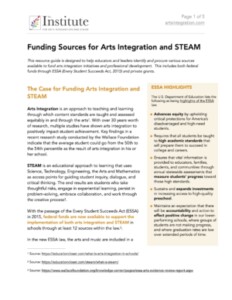
Enjoy this free download of the Arts Integration Funding resource.
Free download (PDF)Show Notes
Alison’s Instagram – https://www.instagram.com/ghousestudio/
Alison’s Facebook – https://www.facebook.com/ghousestudios
Episode Transcript
I live in Norris, Tennessee, which is not very far from Knoxville. So we’re in East Tennessee. And last summer in June, I got my arts integration certification.
How did you, why, first of all, how did you find arts integration? I always think that that’s interesting. And then how did that evolve over time?
So when I’m speaking today, I’m speaking about Norris Elementary. Both of my elementary schools are outstanding. I just wanna put that out there. But my principal at Norris came to me and we spoke about trying to find ways to infuse the arts into curriculum and into the student’s day more and being a very artistic learner myself, and both her and I having our own personal children who are artistic learners, we thought this would be a really cool thing for us as a school to try and just research and see how can we infuse more arts into the day. We have a great art program. We have a great music program, but you know, let’s push it further.
What does that look like? What does that what does that mean for our school? And so I started researching, I, one of the first things I read was Shake the Sketch by Susan Riley.
Also, I attend the Tennessee Arts Academy every summer in Nashville, which is like the best arts training for teachers
So I went to my principal and I said, can we do this? And she said, yeah, let’s do it. So I signed up and I thought I knew what arts integration was. I really did, I had no idea.
So what, what does that mean? I know what that means, but what does that mean for you? How does, what does that statement mean?
And then when Typh talked about the cupcake versus the jelly roll, like how to really tie the two standards and it was so much more academically based. What I learned from the Institute was so academic. Yeah. And it’s like, it’s undeniable. It, it is just, I can’t, I don’t even, I, I’ve lost my train of thought.
Now it’s okay. But no, it’s just really more,
Right. Which is what we were, you were just referring to is, is the connection to standards. Absolutely. Which, can be scary if we’re, if we’re really honest. Tell me about your standards journey, because everybody has a moment when they’re working on aligning standards where they’re like, this is hard.
What are they doing and how are they gonna benefit from this standard? Yes. You know? And so it made me of course I can look now at core content and art standards and, and see them differently but it made me just a better art visual arts teacher because I’m like, what am I really asking them to do?
How is this going to grow them as students, as art students or any kind of student? How are they gonna grow? From beginning to the end of the project or the year because I really now know that verb in the standard is what I really want them to do. And so it’s very intentional.
Right. So you got, you went through the, the certification experience. Yes. And if you were to describe that to somebody who is just considering it, what are some things that you would advise for them?
So it, it was just paced so easily. And the con, I mean, there was some times when it was really hard, don’t get me wrong, like it was hard. And I had to give myself a chunk of time each week that said, this is the time I’m gonna work on this. You know, part of the sprint.
Like, you have to again, be intentional about doing the work. But I never felt overwhelmed. I never felt like, oh my gosh, I can’t do this and my full-time job and, you know, raise my child and, you know, all the things. It never felt overwhelming. It was a lot of work, but it was exciting work and I could immediately take what I learned in each sprint and put it into in my job. And so because it was, I was learning and putting it into practice almost immediately, it was just, it was just seamless, you know?
Yes. And I felt like there was times when I was like, oh, I forgot we had a, a zoom. And just the grace that’s given was very, very helpful to not feel like guilty if some, you know, if you missed a deadline or you know, everyone kind of like understands this is life, you know? Yeah. That’s really… Professors in college that weren’t like that,
And so we will only accept applications from Title I schools. So I kind of like stopped that grant , I’m, I’m gonna write it, I’m gonna try again. And so this past year it reopened, it was the, the cycle had come around again and it reopened and they had taken out the Title I requirement. They did say that priority would be given to Title I schools, but you didn’t have to be a Title I school to apply.
And I was like, hot diggity dog, we’re, we’re going for it. .
And it’s $55,000 for three years, but we have to provide a half match. So, which is a whole separate challenge. But, which is fine. I’m learning so much about grants, but it’ll be 80, a little over $80,000 over the course of three years, all for arts integration and arts programming in our school.
And we have the most special dance teacher. She, she comes twice a month, teaches the whole school. And she went to our, she went to this school. She’s an alumni of this elementary school. Oh, that’s great. And the thing that I think is so special, bringing dance to our school is, and one of the things I learned while I was in the certification program is you have to still have art and music and dance to teach the students the base.
So then when one of our classroom teachers does an arts integration dance lesson, those kids are comfortable with choreography and they know that she’s teaching lots of terms and she’s, you know, so that base and dance is something that the my, my principal and I, we have really been wanting, we actually got mirrors in the gym before Covid hoping to start a dance program. And then of course Covid happened and we kind of went on survival mode for a couple years. But now we’re, we are able to fund this visiting artist to our school, which is like, so exciting.
And I think it’s one of the things that is such a shame for all children because movement is so central to who they are, especially at the elementary grade level. So the fact that you have that now is phenomenal. I’m so glad that this grant has enabled you to kind of work and have that with, with them.
You, you said that you’re learning all the things about grants. Can you tell us a little bit about how you navigated that grant process? Like, how did you make sure that this was gonna, like award as much as you possibly could? What sets you up for success and what are some maybe things that people need to know on the flip side when you get the grant that you were not aware of before?
Also, gave us plenty of time. We had to gather letters of support from the director of schools, the principal community members. So that, making sure that those people who had to have a part in writing the grant had plenty of time was important. We also broke down the grant cause it was really big to write, and I said, okay, this, in the next two weeks, we’re gonna just focus on this.
And let’s get together. I will write. And then we’ll get together and we’ll massage. Getting ready. And so just giving yourself plenty of time. You can’t look at a grant and say, well, let’s do next week. I bet I can knock this out. You, you really can’t do that. And so there are some small grants that maybe you could, you know, get pulled together in a week. But this took us several months of working as a team and having plenty of time for people to edit and having other eyes look at it. And then on the flip side, now that we have the grant, I am not a bookkeeper, so you’re trying to keep up with how the money’s spent and how we then put it back into the grant portal.
That has been a new and interesting challenge for me is trying to keep up with all that.
Right. And I think. We oftentimes think you’re gonna get a grant and then that’s it. That’s, you get the grant, you get to spend the money, and then, but there’s so many other things that go into it. Do you have an end of three year project that you have to work towards?
And Tennessee Arts Commission has a teaching artist roster from which you choose from. So we’ll do, we did one in Fall with this amazing Nashville-based children’s author and performer, and she came and did amazing programming with us. And then, well, every year we’ll have two different teaching artists off that roster.
We have to submit a variety of different things throughout the year to the Tennessee Arts Commission. I don’t think that there’s anything specific that they require, like as a culminating project. But for me, for us as a school, my next goal is to figure out how to continue funding after the grant money runs out. Especially for the dance program, so that we’re able to continue that. So I’ve been talking with our education foundation locally.
They provide grants, small grants to local teachers. But I’ve been just talking with them, talking with our PTO and different groups, trying to find different avenues to continue funding after the grant ends.
How to implement that in their classroom so that even if there’s no money afterwards, you have at least that, that base, which I think is really… So what are some challenges that you’re seeing with your, the program as it is right now, and how are you, this is the part I’m really curious about, how are you overcoming those challenges?
And so a challenge for the classroom teachers is finding space in that tight pacing guide to feel comfortable bringing in an arts integration lesson. And so what I have been working with them on is making that exchange. What can we remove out of what you’re already doing and put something else in its place.
And a great example is the kindergarten curriculum. They read the 3 Little Pigs and they do the retelling of it during, they have like a whole fairytale unit. And in the workbook, in the ELA workbook, there’s a page that you tear out and there’s like a picture of a pig and you cut the pig out and you glue the pig to a Popsicle stick.
And then they use it to retell the story. And I’m like, that is terrible, and roll that page away. Thanks. And let’s let the kids design their own pig puppet from start to finish. And we did it this year and by golly, those kids were so proud of those pigs. Like, which pig are you gonna make? You know?
And they had all kinds of loose part supplies. You know, they had foam and they had, and they had paper, and they had markers and they, I mean, and they talked, we talked about how they would put it together. You know, what, what other supplies are we gonna need to make this happen? And they’re gonna remember that way more than cutting out the face of the pig.
And that was an exchange, right? So that’s just taking out one lesson that is not a very strong lesson and then exchanging it with something else. And the teachers were super excited about that opportunity. The kids of course loved it. Of course. So, things like that. The challenges of finding places to infuse the arts when you already have a really tight curriculum, a really tight pacing guide. So that is one challenge. And then I had another one, but now I can’t remember what it was.
And that that is one section that we talk about is the, is finding the spaces in your curriculum where there’s either reteaching or extensions or multiple lessons on the same concept that are happening that you could maybe take out, right. Like two of the reteaching because you’re just, you’re reteaching the same concept.
And what, what kills me about reteaching lessons? I understand their purpose, but what kills me about them is that the kids who didn’t get it the first time, they’re not gonna get it by the third time that you reteach because you’re reteaching the same way.
Yeah. Which I think sometimes we, we have to get creative in those, in those tight pacing guides, which I understand the purpose of them. And they’re, they do serve a purpose for those who need them. Right. If we can, if we can do that exchange like you shared, I think it’s so powerful because it, you’re right, it’s, it’s a different modality.
The kids who didn’t get it the first time, at least have a chance of getting it this time.
Like she’ll put other things in there, she’ll do little strategies in, but making these nine and, and she’s, she’s so good at aligning them with like your Christmas break. And kids wanna do something hands on movement more anyway, you know, and so she, she really has done a great job planning and looking at where she can fit it in, you know?
Yeah. And that does take some pre-planning. You can’t just say, okay, I’m gonna do it this week. Just like the grant you look at the time frame you have. Like what am I doing for the next nine weeks and sit down and really make a plan. And where can I fit this? . Yeah, it can happen. It totally, for sure.
You know, in this way I want to use arts integration strategies. I want… like, give yourself some time, say, you know, this year we’re gonna do one arts integration lesson in the fall and one in the spring. Yeah. And see how it goes. Yeah. And then if those are successful, then next year, do four.
And then research some other drama games that you can, you know, stick in between that are quick, easy strategies. Yeah. You know, and so feeling like I want all to happen right now, it just can’t, it can’t. Yeah. And so I think that’s my biggest mind shift is like, patience and time .
So I know when, when people get into the arts integration, they get so excited and we so wanna get everybody on board. And it just, sometimes it takes a little bit longer , and that’s okay.
We have done a lot this year. Like think about all the great things that are happening and just, you know, celebrate and, and root for each other.
Even if we’re going slow. I’m, I’m here with you. Yeah. I’m in it with you and I’m excited for you. Right. It’s such an amazing culture to have. So, before I close out, this is a question I always ask everybody, what is one thing that you want people to know about creativity?
But creativity in art is a skill that needs to be, to be built. And so I think that you have to spend time, you know, teaching yourself to be creative and building that skill. When my son was in kindergarten, his teacher asked him to read 20 minutes every because that she wanted him to become a better reader.
And so I ask a lot of adult, my adult learners and, and coworkers and things what do you do for 20 minutes a day to build your creativity or if you wanna be better at painting? Do you spend 20 minutes a day? Because we ask kids all the time to spend 20 minutes a day reading or do this, or do you know?
Well, as adults we don’t give ourselves the time to grow as creative humans, you know, I wish I was more creative. Well, you gotta work at it.
I think about when my, when my daughter was in elementary school, how many times she brought home a math packet for Christmas break, like over the right, over the 14 days. Ha. She had to do a math problem every single day on that calendar, right? Yes. Wouldn’t it be great if as adults we got a calendar of like creative exercises to do?
So how can people stay in touch with you, Alison? How can they find you?
It’s a pleasure getting to speak with you today. I really appreciate it.
Learn more
About the podcast
The Art Works for Teachers Podcast helps teachers crack the code of creativity and use it as a hidden advantage in the classroom. Each week, we’ll use “creative clues” from authors, artists, and teachers to unlock the power of the arts and where it can take us in education today.