
Key takeaways
- Collaborative planning brings content or grade-level teachers and arts specialists together to look at student strengths and challenges and build lessons that treat both areas equitably.
- It rests on four elements: cross-disciplinary collaboration, shared ownership, a student-centered focus, and equitable treatment of both content areas.
- A typical process moves from planning on your own, to finding connections, to creating aligned standards, assessments, and strategies. Then you teach the lesson, sometimes as co-teachers, and reflect.
- The Arts Integration Collaboration Guide gives a sample step-by-step process, and the STEAM Process Planning Guide uses the six steps of the STEAM process to plan larger units.
- A collaborative planning video with Renee Schumacher and a free Scope and Sequence Planner, with a tab for each grade K-12, help you plan a full year in one place.
Collaborative planning is a process where educators from content-area/grade-level classrooms and arts specialists work together to analyze student strengths and challenges and develop lessons that address both areas equitably.
Key Elements of Collaborative Planning:
- Cross-disciplinary collaboration : Bringing together expertise from different subject areas (e.g., a math teacher and dance teacher planning together)
- Shared ownership : All educators contribute insights and suggestions equally
- Student-centered focus : Analysis of what students know, need to know, and how they will demonstrate learning
- Equitable treatment of both content areas in the planning and assessment process
Collaborative planning typically follows a framework that includes:
- Pre-planning individually (often using a matrix to organize thoughts)
- Coming together to identify connections between subjects
- Creating aligned standards, assessments, and instructional strategies
- Implementing the lesson (sometimes co-teaching)
- Reflecting on the process and outcomes
Tools to Support Your Collaborative Planning Efforts
We have a variety of tools, frameworks, and templates to support your collaborative planning efforts. Use these to make this process more streamlined and time-mindful.

Keeping in mind that no two collaborative efforts for an arts integration lesson will “look” the same, we’ve created this sample step-by-step guide as a great place to start. Read the full article and process steps here.

Looking for a simpler way to plan larger units? Try this Essential’s Planning Tool. It uses the 6 steps of the STEAM process as a guide to consider the essentials for connecting, teaching, and supporting students. Read the full article with video tutorial here.
Collaborative planning is essential to authentic arts integration and STEAM experiences. But how do you build that in with all the other curriculum requirements and a jam-packed day? In this workshop preview, educator Renee Schumacher shares her favorite collaborative planning tools for making the process simple and convenient.

GET THE FREE SPREADSHEET
Scope and Sequence Planner
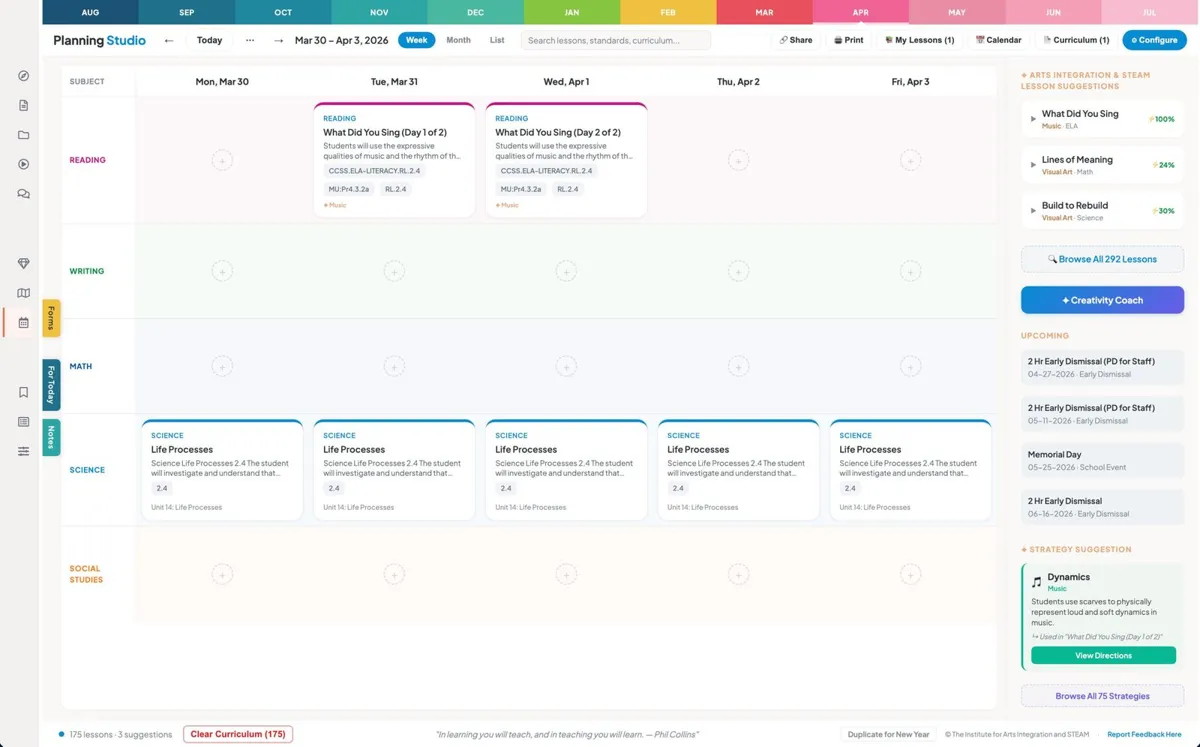
Collaboratively plan a year’s worth of Arts Integration & STEAM lessons in one document. Includes tabs for each grade level, K-12.
Learn more